
Debunking the Belief That FAST Skews Older
Most independent CTV media plans carry an unspoken assumption: catalog content draws older viewers, and older viewers command lower CPMs. The logic feels intuitive. A channel running Forensic Files reruns for instance or 1960s westerns reads as heritage programming, and heritage programming has historically meant a 55-plus audience that premium advertisers would rather avoid. Buyers price accordingly, and the category gets chronically undervalued as a result.
However, the audience data does not support this picture. Ionic's supply data shows the peak age demographic across its portfolio is 25-34, despite a content library anchored in true crime, classic westerns, and culinary competition programming. Most of the titles are decades old yet the viewers pulling them up on demand are not!
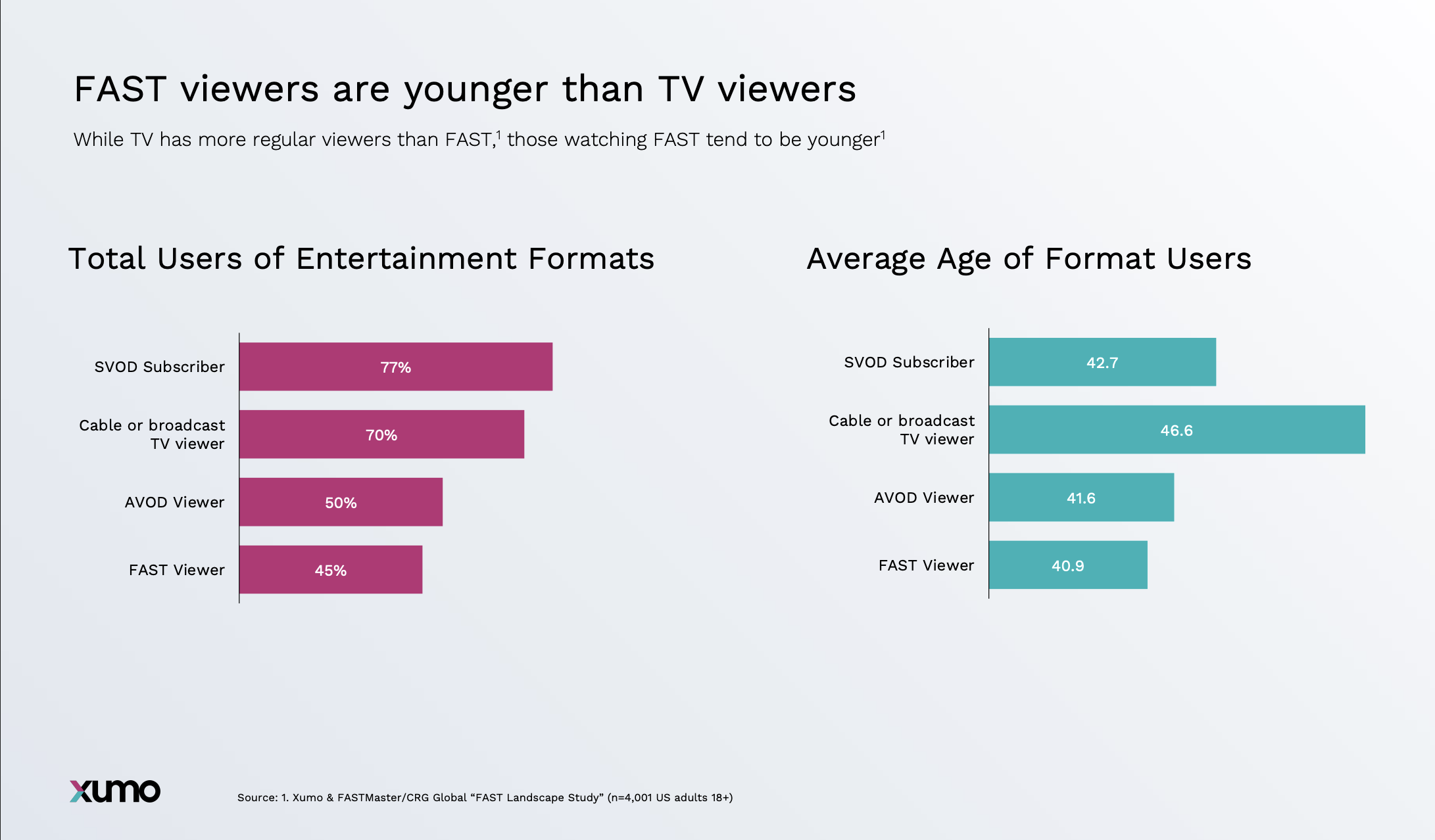
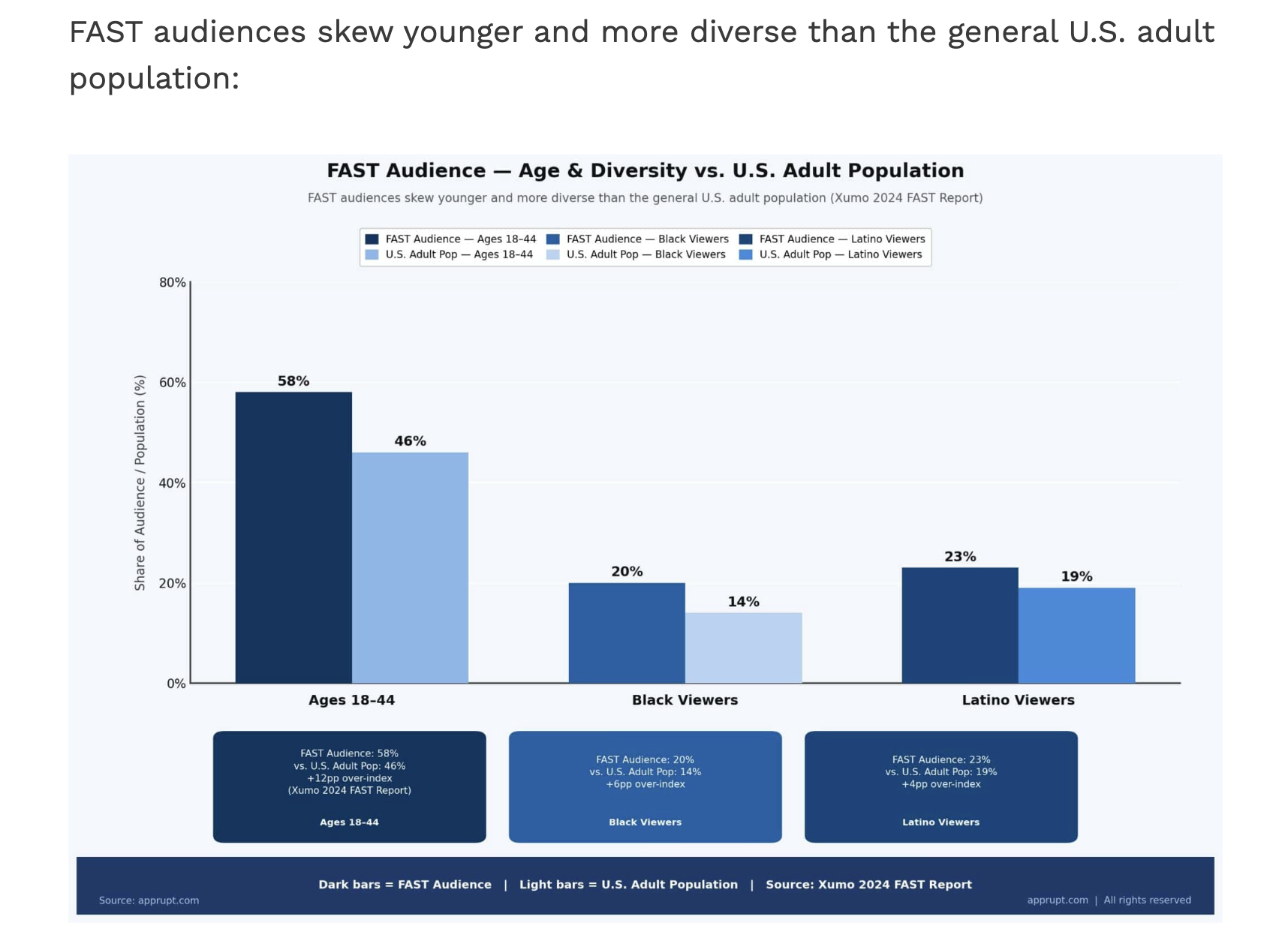
The Xumo 2024 FAST Report provides a broader context. Among regular FAST viewers, 58% fall between the ages of 18 and 44, compared to 46% of the U.S. adult population in that same range, a 12-percentage-point over-index. The average FAST viewer is 40.9 years old, younger than the average SVOD subscriber at 42.7, and well below the 46.6 average for cable and broadcast TV viewers. The medium that buyers routinely price as a catchment for cord-reluctant older audiences is actually drawing younger than Netflix subscribers on a mean-age basis.
What changed is distribution, not content. Catalog content has been available for decades, but for most of its run it lived on cable schedules that required a paid subscription and fixed viewing times. FAST platforms changed the access equation entirely. Younger viewers who have never owned a cable subscription are now finding these shows through algorithmic recommendation on Roku, Samsung, and Amazon Fire TV, and watching multiple episodes in a single sitting. The bingeability that streaming unlocked for scripted originals applies equally to catalog unscripted, and the audience that follows from that behavior is considerably younger than the content's original linear demographic would suggest.
This produces an unusual audience composition from an advertiser standpoint: viewers who grew up with the content alongside viewers discovering it as adults for the first time, concentrated in the 25-44 range, with a household profile that skews toward financial stability.
Within the Ionic portfolio, 43% of viewers report annual household income above $100,000, 68% are married, and 62% have at least one child at home. Catalog FAST is not reaching a marginal audience that more desirable inventory has left behind - it is reaching a settled, mid-career demographic that the rate card has simply failed to price correctly.
Independent CTV has been historically undervalued by buyers who lack audience-level data to push past category assumptions. When the only available signal is the title of the content, and the title conjures a memory of late-night cable, the 45-plus CPM floor becomes self-reinforcing. Ionic Studios is working to break that cycle by surfacing the data buyers have not had access to, because the gap between what this audience actually looks like and what the market is willing to pay for it is where the real opportunity sits.